Here is a link to Uncle Bob's talk about Clojure. As always, he explains basic stuff in a cool way. Have fun as I had.
Monday, 28 January 2013

Tuesday, 15 January 2013
The A Team has A players
I think, we all know that universities' programmes do not conform well to industry requirements. I would be even tempted to state that computer science and IT are the most vulnerable subjects, in terms of coherence between what is taught and what is required. Basically, teaching too much science can affect industry skills. What I mean is a proportion of industry to science skills (I/S). To my mind, it should be close to 1:1 proportion. In fact, we often observe much higher contribution of science, comparing to industry one. My guess, based on my private research, would be that nowadays the ratio is floating somewhere between 1:4 to 2:3.
So these are things and topics required by companies from people they are hiring. Now think, how many of these you were taught at university and how many of them you were taught and you know on a decent level.
Good Recruiter
We were talking about proper set of skills for new joiner. Now let's think about person I call a good recruiter and let's analyze his approach to a candidate. A good recruiter is somebody, who is able quickly and honestly estimate the level of developer. So how they think?
First of all, small companies pays attention for knowledge. Secondly, the most important language in IT is English. It is a sort of must be nowadays and at least good command of English is essential. The candidate should also have a correct financial self esteem and knowledge of market trends at his work. A good recruiter should also check skills, which developer will be using all the time at work i.e.:
- naming variables and methods,
- IDE knowledge,
- way of writing tests
- refactoring
These are things, which new developer will be coming across on a daily basis and these sort of things should be checked. Please, give me a break with intelligence tests and questions about falling bulb from the skyscraper etc. It's all pointless! Check real skills, which will be used in real life, not some artificially invented questions to show off to the recruited person.

To be clear, I have nothing against science. I am even extremely keen on science from my childhood. What's more, I always saw a huge value in being open minded and having analytical skills.
On the other hand, some knowledge of current, top industry technologies, approaches and tricks is of at most importance. These are your tools. You will be using them on a daily basis. You have to know how to use them!
Okay, rather than grumbling and ranting, let's go straight to the definition of set of requirements and skills necessary in industry. Incidentally, these might be things necessary in science, as well.
Below requirements were initially defined and put together by Wojtek Seliga, but then enriched in few places by me:
Below requirements were initially defined and put together by Wojtek Seliga, but then enriched in few places by me:
Basic programming skills:
- java.util.concurrent package
- GC (how it works, types)
- Socket programming and threads
- TCP/IP, HTTP (Basic Auth, Cookies, Session)
- Scalability - how to build scalable apps
- Performance - how and when to pay attention for performance
- Transactions - types of transactions
- CAP rule
Java Core:
- interface, class
- composition, inheritance
- collections
- complex types, algorithms
- hash code, searching complexity, putting complexity
- concurrency (thread, monitor, synchronization different approaches, semaphore, cyclic barrier, latch)
- streams
- immutability (thread safe, object pools)
- reflection, AOP, byte code manipulation, generation, dynamic proxy - it explains how dependency injections frameworks, testing libraries work
- Web technologies stack: Struts, Filter, Servlet, Server socket (socket bind accept)
Libraries:
- JDK a lot of classes, on the other hand, not so many to scroll down and eyeball check
- Guava - very good library
- Apache Utils
- Yoda Time - don't use Date and Calendar
- Spring, Nano, Pico, Guice - as dependency injection frameworks
- Spring, Nano, Pico, Guice - as dependency injection frameworks
Tools:
- know some IDE (keyboard shortcuts, IDE shouldn't slow you down)
- debugger (not System.out.println all over the place)
- profiler (bottleneck, deadlock)
- internet traffic analyzer (WireShark, Fiddler), FireBug
Books:
- Effective Java 2nd edition (Joshua Bloch) - after reading you think you know everything
- Java concurrency in practice - after reading you think you know nothing
Personality:
- intelligent, smart, active
- intelligent, smart, active
- willing to change and go out from his comfort zone
- looks for new technologies, experience, A players are not worried to suggest something new, because even if new idea wouldn't work they learn on their own mistakes
- they have high self esteem (often times it's correct)
- they can often find a job
- pragmatic
- there is some 'public track' of them in the internet (forums, blogs, conferences, twitter etc.)
- looks for new technologies, experience, A players are not worried to suggest something new, because even if new idea wouldn't work they learn on their own mistakes
- they have high self esteem (often times it's correct)
- they can often find a job
- pragmatic
- there is some 'public track' of them in the internet (forums, blogs, conferences, twitter etc.)
So these are things and topics required by companies from people they are hiring. Now think, how many of these you were taught at university and how many of them you were taught and you know on a decent level.
Good Recruiter
We were talking about proper set of skills for new joiner. Now let's think about person I call a good recruiter and let's analyze his approach to a candidate. A good recruiter is somebody, who is able quickly and honestly estimate the level of developer. So how they think?
First of all, small companies pays attention for knowledge. Secondly, the most important language in IT is English. It is a sort of must be nowadays and at least good command of English is essential. The candidate should also have a correct financial self esteem and knowledge of market trends at his work. A good recruiter should also check skills, which developer will be using all the time at work i.e.:
- naming variables and methods,
- IDE knowledge,
- way of writing tests
- refactoring
These are things, which new developer will be coming across on a daily basis and these sort of things should be checked. Please, give me a break with intelligence tests and questions about falling bulb from the skyscraper etc. It's all pointless! Check real skills, which will be used in real life, not some artificially invented questions to show off to the recruited person.

The best boss is the most stupid person in company
There is also a concept of A players. Companies should hire only A and A+ players.
A players have rightly high self esteem. That's why the best boss is the most stupid boss, as he knows that only by hiring people better than himself, he will be able to build valuable company.
B players are scared a bit. They don't know what other will say. They are a bit lost. B player is hiring weaker, than himself.
C players - misery.
People tend to blindly repeat that developer is the most precious asset of the company.
If yes, why companies are rising salary when precious developer is quitting?
If developer is so important, stop your most significant project and put the best people (A and A+) to interview, because you can loose cool guy, who is waiting for his turn out there. He will pay off 100 times anyway.
What we see in reality is that companies are sending whoever to interview new, fresh blood to the company. Is it the right move? Is it how it should be done? Definitely not.
If company really truly believes that developer is the most important asset for them, they should use their best people to recruit others.
Remember: The A team has only A players.
There is also a concept of A players. Companies should hire only A and A+ players.
A players have rightly high self esteem. That's why the best boss is the most stupid boss, as he knows that only by hiring people better than himself, he will be able to build valuable company.
B players are scared a bit. They don't know what other will say. They are a bit lost. B player is hiring weaker, than himself.
C players - misery.
People tend to blindly repeat that developer is the most precious asset of the company.
If yes, why companies are rising salary when precious developer is quitting?
If developer is so important, stop your most significant project and put the best people (A and A+) to interview, because you can loose cool guy, who is waiting for his turn out there. He will pay off 100 times anyway.
What we see in reality is that companies are sending whoever to interview new, fresh blood to the company. Is it the right move? Is it how it should be done? Definitely not.
If company really truly believes that developer is the most important asset for them, they should use their best people to recruit others.
Remember: The A team has only A players.
Monday, 10 December 2012
Code Retreat in ThoughtWorks 2012
This time I was in taking a part in Code Retreat organized by London branch of ThoughtWorks and it was awesome !!

I decided to spent half of a day writing code in languages other than Java. I have chosen Groovy, Ruby and C#. I have to say that all sessions went very well. Okay, so let me describe them briefly:
#session 1: Groovy with no constraints - just a warm up in a language similar to Java.
#session 2: Java and baby steps - this one was very good. The quite nice and neat design was emerging from the code driven by our tests.
#session 3: Ruby and no more than 4 lines of code per method - actually 4 lines of code per method wasn't hard to achieve in Ruby. To be fairly honest, the longest method we had, had literally 2 lines. What's more, Ruby guy, I was pairing with, has shown me some magic in Vim. I thought I knew Vim quite good, however it appeared I am a barely novice :P
#session 4: Java and immutable objects - this was actually quite interesting one, as well. Immutable objects were affecting our design in a way we did not expect, at the very beginning.
#session 5: Java and no primitives - again another interesting design emerged.
#session 6: C# and tell don't ask (our choice) - that was actually quite a challenge to use only procedures.
All in all, it was very educational, eyes opening and enlightening day. Although there were couple of tricks I learned, I think the most valuable one is related to the way of coping & pasting code. If you really need to do it, do it as below:
- copy & paste the code
- use question marks to denote parts of code you have to amend
- replace question marks with valid code starting from the top
Just to make things clear, let's have a look on a below example:
"Any live cell with fewer than two live neighbours dies, as if caused by under-population."
And here you decided to copy above test in order to tweak it slightly, so that you can get another valid test.
"Any live cell with more than three live neighbours dies, as if by overcrowding."
And here is the result:
As simple as that, but helps you to avoid silly errors.

I decided to spent half of a day writing code in languages other than Java. I have chosen Groovy, Ruby and C#. I have to say that all sessions went very well. Okay, so let me describe them briefly:
#session 1: Groovy with no constraints - just a warm up in a language similar to Java.
#session 2: Java and baby steps - this one was very good. The quite nice and neat design was emerging from the code driven by our tests.
#session 3: Ruby and no more than 4 lines of code per method - actually 4 lines of code per method wasn't hard to achieve in Ruby. To be fairly honest, the longest method we had, had literally 2 lines. What's more, Ruby guy, I was pairing with, has shown me some magic in Vim. I thought I knew Vim quite good, however it appeared I am a barely novice :P
#session 4: Java and immutable objects - this was actually quite interesting one, as well. Immutable objects were affecting our design in a way we did not expect, at the very beginning.
#session 5: Java and no primitives - again another interesting design emerged.
#session 6: C# and tell don't ask (our choice) - that was actually quite a challenge to use only procedures.
All in all, it was very educational, eyes opening and enlightening day. Although there were couple of tricks I learned, I think the most valuable one is related to the way of coping & pasting code. If you really need to do it, do it as below:
- copy & paste the code
- use question marks to denote parts of code you have to amend
- replace question marks with valid code starting from the top
Just to make things clear, let's have a look on a below example:
"Any live cell with fewer than two live neighbours dies, as if caused by under-population."
@Test
public void liveCellWithFewerThanTwoLiveNeighboursDies() {
	int oneNeighbour = 1;
	Cell liveCell = new Cell(ALIVE, oneNeighbour);

	liveCell.tick();

	assertThat(liveCell.getState(), is(equalTo(DEAD)));
}
And here you decided to copy above test in order to tweak it slightly, so that you can get another valid test.
"Any live cell with more than three live neighbours dies, as if by overcrowding."
@Test
public void liveCellWith???NeighboursDies() {
	int ???Neighbour??? = ???;
	Cell liveCell = new Cell(ALIVE, ???Neighbour???);

	liveCell.tick();

	assertThat(liveCell.getState(), is(equalTo(DEAD)));
}
And here is the result:
@Test
public void liveCellWithMoreThanThreeLiveNeighboursDies() {
	int fiveNeighbours = 5;
	Cell liveCell = new Cell(ALIVE, fiveNeighbours);

	liveCell.tick();

	assertThat(liveCell.getState(), is(equalTo(DEAD)));
}
As simple as that, but helps you to avoid silly errors.
Saturday, 24 November 2012
Manager in Agile team.
There is no manager in Agile team.
It might be hard to believe, but developers know what needs to be done, as they have backlog and their own brain!
They do not need another guy, who is cultivating seagull management.

And now shit load of stuff is getting a new meaning :P

It might be hard to believe, but developers know what needs to be done, as they have backlog and their own brain!
They do not need another guy, who is cultivating seagull management.

And now shit load of stuff is getting a new meaning :P

Saturday, 10 November 2012
Which game are you playing ?
Few days back, I spoke with my friend about pretty "funny" situation. He told me that developers at his project are playing a game, which my friend called Pair Programming vs. Code Review. If developers like each other, they play Pair Programming. If they do not like each other, then they play Code Review.

The overall idea is very easy to grasp and simple. Let's look at pair programming from two, different perspectives: tiger and dragon.
Scratching Tiger:
Hidden Dragon:
And now comes the most important part. Developers are creating a collective mind, which is buzzing and boiling due to new, fresh ideas. The worst thing you can do, is not switching between Tiger and Dragon role. You have to do it frequently, without any hesitation and freely. You cannot be afraid of your partner saying leave that keyboard, etc. When you see Tiger did a typo, initialized a loop in a wrong way or did not do refactoring, which might be done - simply take over and use your own keyboard to fix it. You need to change perspectives very often and switch your brain from linear to non-linear mode and vice versa. That is the only way you can solve difficult problems.

It is definitely more expedient to pair on crucial and strategically important tasks. It is also useful to pair on both very hard, non-trivial implementations and medium level difficulty tasks. There is no use of pairing on relatively easy tasks, as they do not add so much value, comparing to effort.

As you can see those developers found a problem, where it was not even existing. That's a rare and undesired skill, which often manifest itself in pseudo pragmatic teams, who are probably not sticking to 5th Agile manifesto principle:
"Build projects around motivated individuals.
Give them the environment and support they need, and trust them to get the job done."
Generally, it is called over-engineering! But not only that, they are loosing time for guerrilla warfare, rather than focusing on helping each other. They also seem not to have any respect to each other.
The question is: should it be this way? Of course, no!
I would like to be clear about Pair Programming and Code Review, so let's start from some definitions.
"Build projects around motivated individuals.
Give them the environment and support they need, and trust them to get the job done."
Generally, it is called over-engineering! But not only that, they are loosing time for guerrilla warfare, rather than focusing on helping each other. They also seem not to have any respect to each other.
The question is: should it be this way? Of course, no!
I would like to be clear about Pair Programming and Code Review, so let's start from some definitions.
Scratching Tiger, Hidden Dragon - Pair Programming
One developer types in code at the keyboard. He works at the tactical level. The other one looks for mistakes and thinks strategically about whether the code is being written right and whether the right code is being written.
You can also describe pair programming in a more holistic and tao oriented way, as a yin-yang or a unity and harmony arousing from diversity. There are many approaches explaining principles of pair programming like coder and observer, driver and navigator, however I am always keen on scratching tiger and hidden dragon parallel.
You can also describe pair programming in a more holistic and tao oriented way, as a yin-yang or a unity and harmony arousing from diversity. There are many approaches explaining principles of pair programming like coder and observer, driver and navigator, however I am always keen on scratching tiger and hidden dragon parallel.

In other words, it is a conjunction of opposite features like active and passive, linear and non-linear or specific and general in a collective action such as solving a problem - programming in this case.
To be fairly honest, one can extend and generalize this approach to any sort of task you have got to do. The overall idea is very easy to grasp and simple. Let's look at pair programming from two, different perspectives: tiger and dragon.
Scratching Tiger:
- Active person writing the code, almost scratching it
- Keeps on focusing on syntax and details
- Uses his linear part of brain, logical (left) hemisphere to solve arousing problems
Hidden Dragon:
- Passive person pays attention to code quality and acceptance criteria fulfillment, almost like dragon, flying in the sky and observing what tiger does
- Can see whole solution, has an overall idea of subsequent tasks and steps
- Uses his non-linear part of brain, abstract (right) hemisphere to imagine a flow and grasp the bigger picture
How can we get the movement ?
Again, this is simple. You need a proper space. Comfortable desk, two chars and two keyboards. These things are really important, so do not neglect any of it, especially two keyboards. These prerequisites enable higher level of collaboration between developers. Apart from that they are not loosing time and ideas, while swapping keyboards.And now comes the most important part. Developers are creating a collective mind, which is buzzing and boiling due to new, fresh ideas. The worst thing you can do, is not switching between Tiger and Dragon role. You have to do it frequently, without any hesitation and freely. You cannot be afraid of your partner saying leave that keyboard, etc. When you see Tiger did a typo, initialized a loop in a wrong way or did not do refactoring, which might be done - simply take over and use your own keyboard to fix it. You need to change perspectives very often and switch your brain from linear to non-linear mode and vice versa. That is the only way you can solve difficult problems.

Why pairing on solving tasks?
Mainly because of four reasons:- Readability - two people take care about readable code, both of them have to understand what was written
- Code quality - percentage of defects found 40% - 60% (Steve McConnell "Code Complete")
- Bus factor - knowledge sharing and mitigating the risk of single point of failure
- Pressure - group shields developers from external pressure much better than single developer can protect himself. What's more, in stressful situations people tend to cluster to face difficult situation.
Okay, so when it is worth to pair?
It is definitely more expedient to pair on crucial and strategically important tasks. It is also useful to pair on both very hard, non-trivial implementations and medium level difficulty tasks. There is no use of pairing on relatively easy tasks, as they do not add so much value, comparing to effort.
Always remember about rotating pairs, not giving an opportunity to get used to your partner. The efficiency is decreasing then. Moreover, it is also good not to pair newbies, as there is not master-apprentice relation, which negatively affects pairing process. Definitely people need to like each other.
Code Review - No junk in a trunk
It is a sort of semi formal walkthrough the code aiming to:
- share knowledge (mitigate bus factor)
- check design from high level perspective
- check at least SOLID rules appliance
- check definition of done (DoD)
- increase resilience before holidays
When can you perform code review?
Of course after development and testing, but before merging to master or trunk, so that there is no junk in a trunk.

The programmer or pair, who developed a solution, walks some other team member through new code. They start from telling the story and acceptance criteria, then they are explaining applied design and showing working, green, CI system tests. There is also a place for Q&A and potentially some code review remarks or changes. Code review is able to discover between 20% to 40% of defects (Steve McConnell "Code Complete").
Summary
Code Review and Pair Programming are two, complementary techniques improving the general quality of the provided solution. Apart from that they mitigate the risk associated with bus factor, by knowledge sharing.
Both of them create a useful unity in development cycle.
You may even use scratching tiger, hidden dragon parallel, in this case, as well. Pair Programming would be a tiger and code review a dragon looking at the solution from the distance.
It is much cheaper (sic!) to let developers be tigers and dragons, rather than giving them a wigging that they loose time for crap.
Rarely you have to choose between these two approaches. Then do it wisely and choose pairing. If your management is trying to be clumsy lean oriented and tells you should not do pairing, as it is a pure waste, take at least code review. Remember, half pairing is still better than not paring at all. It is always good to discuss design, start doing the most tricky bit together and then split and finish what you started separately, if time is so valuable.
However, in fact it does not hold true. You are writing robust and clean solutions faster while paring and reviewing, than not.
Saturday, 27 October 2012

Saturday, 20 October 2012
What's so cool about OO?
When people start reading or talking about object oriented (OO) design, there is always a bunch of quite fundamental questions appearing, at some point.
Ad.1. What does OO design really mean?
Short answer:
It is all about dependency management.
Long answer:
It means breaking source code dependency and diverting it, so that we would get an independent deployability.
Ad.2. Does writing in object oriented language mean I am creating OO design?
Short answer:
No.
Long answer:
OO language is providing you a mechanism, to grow an OO code. The trick is that OO language creates an opportunity of using that mechanism, but nobody is pushing you to do so. That is why you have to be aware of what you are doing and consciously use available language features.
Ad. 3. Why some developers despite using OO language, they do not create OO code?
Short answer:
They do not know what OO design is.
Long answer:
Some developers assume that writing in Java, an OO language, means they are so cool that everything they touch is OO. It is not true. Even worse thing is they do not know how wrong they are. This is sad, but often it is true.
Ad.4. How is OO language different from functional one?
Short answer:
These two approaches are very different.
Long answer:
These are two, entirely different concepts. Each of them has its own strengths and limitations. We have to know both sides to choose wisely what we need. Same time, we have to be aware of the consequences of our choice.
Object oriented languages have a very good dependency management mechanism. On the other hand, functional approach is much better in terms of:
Ad.5. What is the first class citizen in OO and functional approaches?
Short answer:
Object oriented languages: objects.
Functional languages: functions.
Long answer:
Functional languages: functions.
Object oriented languages: objects, but to be fairly honest the interface is the one, who is a major player.
As I said previously, it is all about dependency management. To be more precise, it is all about how to invert source code dependency (aka compile time dependency) against flow of control (aka runtime dependency). To satisfy that idea, we have a set of techniques enabling us dealing with dependencies:
Okay, so what is the beef ?
Again, it is all about dependency management. Let's crack down some simple, but not easy example.
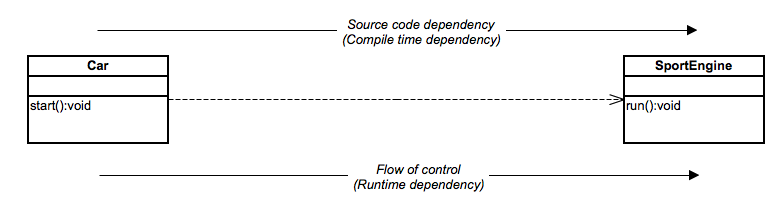
Imagine a car using an engine. The Car object is having a dependency to the SportEngine.
We may crystalize that dependency by saying that Car has a start method, which uses SportEngine's run method. That is how our initial dependency may look like:

As you can see, we have a source code dependency pointing exactly to the same direction as runtime dependency. Source code dependency is an import statement in Car class, which associates Car with SportEngine, in a direct way. Runtime dependency tells you that Car uses SportEngine, so that it can start properly.
The whole idea of solving above problem and many other, similar issues is:
TO BREAK A SOURCE CODE DEPENDENCY AND DIVERT IT.

That is an extremely crucial thing to understand. However, there is one gotcha here. People may think that whole trick is about diverting the compile time dependency arrow from SportEngine to point directly to the Car. This is wrong! It needs to point towards Car, but not directly.
How can we do it ?
Let's introduce a middle man called an Engine, which in fact is a polymorphic interface between Car and SportEngine. The Car class will be using Engine interface, which would have a run method. On the other hand, SportEngine class will be implementing Engine interface.
From now on, we have the source code dependency diverted and pointing towards Car class, at least from SportEngine's perspective. That point of view is one of the most important assumptions, which we need to understand. Only embracing SportEngine's perspective and its source code dependencies allows us to see the bigger picture.
From high level perspective, the whole idea looks easy, however it is only a superficial feeling. In fact, we have to see the problem from three, totally different perspectives (Car, Engine and SportEngine).
Summing up, SportEngine knows about Engine and so as Car class. The runtime dependency's direction remains the same and points through Engine's interface to SportEngine class.

That is what we got:
Real life example.
The almost obvious extension would be to apply above principle on different levels like: classes, modules, components, entire applications or DBs.
- What does OO design really mean?
- Does writing in object oriented language mean I am creating OO design?
- Why some developers despite using OO language, they do not create OO code?
- How is OO language different from functional one?
- What is the first class citizen in OO and functional approaches?
Ad.1. What does OO design really mean?
Short answer:
It is all about dependency management.
Long answer:
It means breaking source code dependency and diverting it, so that we would get an independent deployability.
Ad.2. Does writing in object oriented language mean I am creating OO design?
Short answer:
No.
Long answer:
OO language is providing you a mechanism, to grow an OO code. The trick is that OO language creates an opportunity of using that mechanism, but nobody is pushing you to do so. That is why you have to be aware of what you are doing and consciously use available language features.
Ad. 3. Why some developers despite using OO language, they do not create OO code?
Short answer:
They do not know what OO design is.
Long answer:
Some developers assume that writing in Java, an OO language, means they are so cool that everything they touch is OO. It is not true. Even worse thing is they do not know how wrong they are. This is sad, but often it is true.
Ad.4. How is OO language different from functional one?
Short answer:
These two approaches are very different.
Long answer:
These are two, entirely different concepts. Each of them has its own strengths and limitations. We have to know both sides to choose wisely what we need. Same time, we have to be aware of the consequences of our choice.
Object oriented languages have a very good dependency management mechanism. On the other hand, functional approach is much better in terms of:
- multithreading (immutability out of the box)
- lack of states, which means lack of side effects
- flow oriented applications.
Ad.5. What is the first class citizen in OO and functional approaches?
Short answer:
Object oriented languages: objects.
Functional languages: functions.
Long answer:
Functional languages: functions.
Object oriented languages: objects, but to be fairly honest the interface is the one, who is a major player.
As I said previously, it is all about dependency management. To be more precise, it is all about how to invert source code dependency (aka compile time dependency) against flow of control (aka runtime dependency). To satisfy that idea, we have a set of techniques enabling us dealing with dependencies:
- SOLID principles - helps to manage dependencies in OO design
- Component cohesion principle - describes forces that cause classes to be grouped in the independently deployable components
- Component Coupling principle - describes forces that govern dependencies between components
Okay, so what is the beef ?
Again, it is all about dependency management. Let's crack down some simple, but not easy example.
Imagine a car using an engine. The Car object is having a dependency to the SportEngine.
We may crystalize that dependency by saying that Car has a start method, which uses SportEngine's run method. That is how our initial dependency may look like:
package com.korczak.oskar.blog;

import com.korczak.oskar.blog.engine.SportEngine;

public class Car {

 private SportEngine sportEngine;

 public Car(SportEngine aSportEngine) {
  this.sportEngine = aSportEngine;
 }

 public void start() {
  sportEngine.run();
 }
}
package com.korczak.oskar.blog.engine;

public class SportEngine {

 public void run() {
           // here goes some engine implementation
 }
}
The whole idea of solving above problem and many other, similar issues is:
TO BREAK A SOURCE CODE DEPENDENCY AND DIVERT IT.

That is an extremely crucial thing to understand. However, there is one gotcha here. People may think that whole trick is about diverting the compile time dependency arrow from SportEngine to point directly to the Car. This is wrong! It needs to point towards Car, but not directly.
How can we do it ?
Let's introduce a middle man called an Engine, which in fact is a polymorphic interface between Car and SportEngine. The Car class will be using Engine interface, which would have a run method. On the other hand, SportEngine class will be implementing Engine interface.
From now on, we have the source code dependency diverted and pointing towards Car class, at least from SportEngine's perspective. That point of view is one of the most important assumptions, which we need to understand. Only embracing SportEngine's perspective and its source code dependencies allows us to see the bigger picture.
From high level perspective, the whole idea looks easy, however it is only a superficial feeling. In fact, we have to see the problem from three, totally different perspectives (Car, Engine and SportEngine).
Summing up, SportEngine knows about Engine and so as Car class. The runtime dependency's direction remains the same and points through Engine's interface to SportEngine class.

package com.korczak.oskar.blog;

import com.korczak.oskar.blog.engine.Engine;

public class Car {

 private Engine engine;

 public Car(Engine anEngine) {
  this.engine = anEngine;
 }

 public void start() {
  engine.run();
 }
}
package com.korczak.oskar.blog.engine;

public interface Engine {

 public void run();

}
package com.korczak.oskar.blog.engine;

public class SportEngine implements Engine {

 public void run() {
           // here goes some engine implementation
 }
}
That is what we got:
- Car and SportEngine are separate classes
- Independent deployability
- We can have many different Engines deployed
- Module SportEngine plugs in to Car
Real life example.
The almost obvious extension would be to apply above principle on different levels like: classes, modules, components, entire applications or DBs.
Few days back, I found that principle very useful on a DB level. We got a very tight dependency between us and other project, who had a read only access to our DB. I know that letting even a read only access to other projects is something similar to ripping the application's skin and exposing our guts to the public, but let's not discuss the root cause of that situation. The issue was pretty substantial and causing a lot of annoyance, hurt feelings and other stuff. Every single alter operation on a table like changing the type of field, its length or adding a column was a massive pain for both sides. I will only mention that adding a new table or dropping it was even worse. On a top of that we found that we have different release cycles. Basically, we were required to slow down our process, so that we would conform to the slower project. Incidentally, it was very similar to situation almost all of us had at school. Teacher had always to work as fast as the slowest person in the group, causing others to be pissed off. On the other hand, the slowest guy was also annoyed as everybody was waiting for him. Typical loose-loose situation.
We badly needed a clutch and we found one. The solution was to expose only those business data, the other project needed, via DB views. All the rest say technical data was hidden behind views. We built these views having a well defined interface between us and them. Interface was not changing almost at all and we were independent from the other project. We still could do releases in our pace, without any other external dependency. Other guys were also happy about still DB interface and maintaining their release cycle. Typical win-win situation.
If we examine above case, we easily find that project exposing some data was an allegory of SportEngine and guys reading our DB were a reification of Car. We simply created an interface, which diverted a source code dependency.
Sunday, 14 October 2012
Show Me the Value
Do you recall a well-known phrase uttered by characters in the 1996 film 'Jerry Maguire'?

If one would like to sum up Agile practices in a neatly tailored way:
'Show Me the Value' is one of the best approaches I have ever heard about.

If one would like to sum up Agile practices in a neatly tailored way:
'Show Me the Value' is one of the best approaches I have ever heard about.
Subscribe to:
Posts (Atom)